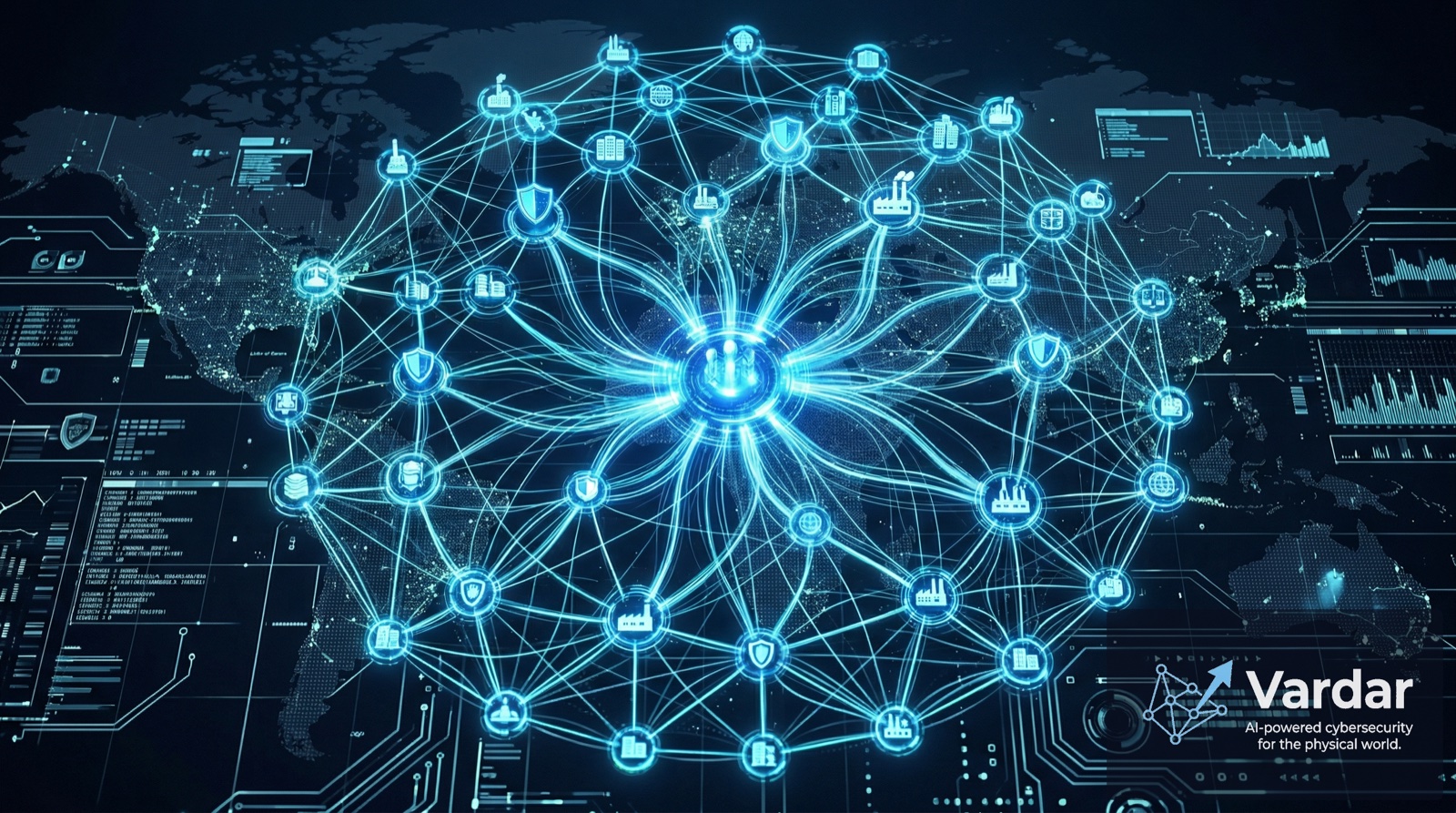
What if every OT environment contributed anonymized threat intelligence to a shared defensive network — so that an attack detected at one site automatically strengthened defenses everywhere else?
Waze transformed navigation not because it had better maps, but because it turned every driver into a sensor. Real-time data from millions of users — reporting accidents, police, traffic jams — creates a continuously updated picture of road conditions that no single mapping company could replicate alone.
Now apply that principle to cybersecurity. This is the concept behind collective threat intelligence, and in 2026, it is shifting from aspirational idea to operational necessity. CISA's 2025 Year in Review reported that the agency published over 1,600 cybersecurity products, triaged more than 30,000 incidents through its 24/7 Operations Center, and blocked 2.62 billion malicious connections across federal networks and 371 million across critical infrastructure environments. The scale of the threat demands a collective response.
Why Isolated Defense No Longer Works
The OT threat landscape has crossed a threshold. According to a recent NCC Group and Dragos joint analysis, state-aligned actors are quietly establishing long-term footholds across critical infrastructure, using "living off the land" techniques, valid credentials, and activity that mimics legitimate administration to maintain persistent access.
These are not smash-and-grab ransomware operations. They are deliberate, patient campaigns designed to pre-position for disruption — and they are targeting the industrial supply chain as an accelerated path to multiple victims simultaneously.
The Fortinet 2025 OT Security Report disclosed that half of all OT organizations fell victim to breaches last year, even as they actively advanced their security programs. The uncomfortable conclusion: individual organizations, no matter how mature their security programs, cannot defend effectively in isolation.
Here is why:
Attackers share intelligence. Defenders mostly do not. Threat actors operating as part of coordinated campaigns reuse tools, techniques, and infrastructure across targets. When one attack succeeds, the playbook is replicated. Without collective defense, each victim discovers the same attack independently — often too late.
The visibility gap is staggering. As one OT security researcher noted during a recent industry panel, "Collectively, we monitor less than 5% of the OT network globally. You could never imagine that statistic in enterprise IT." This means 95% of industrial networks are blind spots where attacks can develop unseen and unshared.
Individual AI models plateau without diverse data. A single organization's behavioral detection model can only learn from its own traffic patterns. It will never see the novel technique that first appeared at a facility in another country, industry, or architecture. Collective intelligence feeds break this ceiling.
How Collective Intelligence Works in Practice
True collective threat intelligence goes far beyond traditional indicator sharing — the exchange of known-bad IP addresses, file hashes, and domain names that arrives hours or days after an attack is already spreading.
The next generation of collective defense operates at three levels:
Real-time behavioral patterns. When an edge sensor detects an anomalous sequence of industrial protocol commands at one facility — say, an unusual combination of Modbus writes that precedes a process manipulation — that behavioral signature is anonymized, stripped of facility-specific context, and shared across the network. Every other facility gains the ability to detect that pattern before it is weaponized against them.
Aggregate trend intelligence. Across hundreds of deployments, collective platforms identify macro-level shifts — new scanning patterns targeting specific device types, emerging exploitation of particular protocol vulnerabilities, or coordinated reconnaissance campaigns probing a specific industry sector. This strategic intelligence enables proactive defense, not just reactive response.
Federated learning without data exposure. Privacy-preserving techniques allow detection models to improve using insights from across the collective without any single organization's raw data leaving its facility. The models get smarter; the data stays local. This addresses the persistent tension between intelligence sharing and data sovereignty.
The parallel to Waze is precise: each participant is simultaneously a beneficiary and a contributor. The network effect means that the system becomes more intelligent with every facility that joins — creating a defensive moat that individual point solutions cannot replicate.
From Compliance Requirement to Strategic Advantage
Regulations are accelerating the shift toward collective defense. NIS2 explicitly encourages threat intelligence sharing, while the EU Cyber Solidarity Act and DORA mandate cooperative frameworks across sectors. CISA's Joint Cyber Defense Collaborative (JCDC) has grown to over 300 public-private partners co-developing playbooks for supply chain attacks, ransomware waves, and nation-state threats.
But beyond compliance, collective intelligence is becoming a competitive differentiator. Organizations that participate in high-quality intelligence-sharing networks detect threats faster, suffer fewer breaches, and recover more quickly. As one energy-sector CISO described it, collective defense "exponentially increases visibility into the threat landscape," enabling even smaller companies to benefit from intelligence at scale.
At Vardar, collective intelligence is not an add-on — it is architectural. Our Hive Mind system aggregates anonymized behavioral patterns across all deployments, turning every protected facility into a sensor that strengthens the entire network. Each Edge AI Sentinel operates autonomously at the local level while contributing to and benefiting from the collective. When a novel OT threat technique is detected anywhere in the network, every connected facility's detection capability is updated — automatically, in near real-time, without exposing any organization's operational data.
Strength in Numbers
The cybersecurity industry has long debated whether organizations should share more threat intelligence. In 2026, the debate is effectively over. The scale, sophistication, and coordination of threats targeting industrial environments demands an equally coordinated defense.
The question is no longer whether to participate in collective intelligence — it is whether your collective platform is fast enough, granular enough, and privacy-preserving enough to make a real difference at the speed of OT.