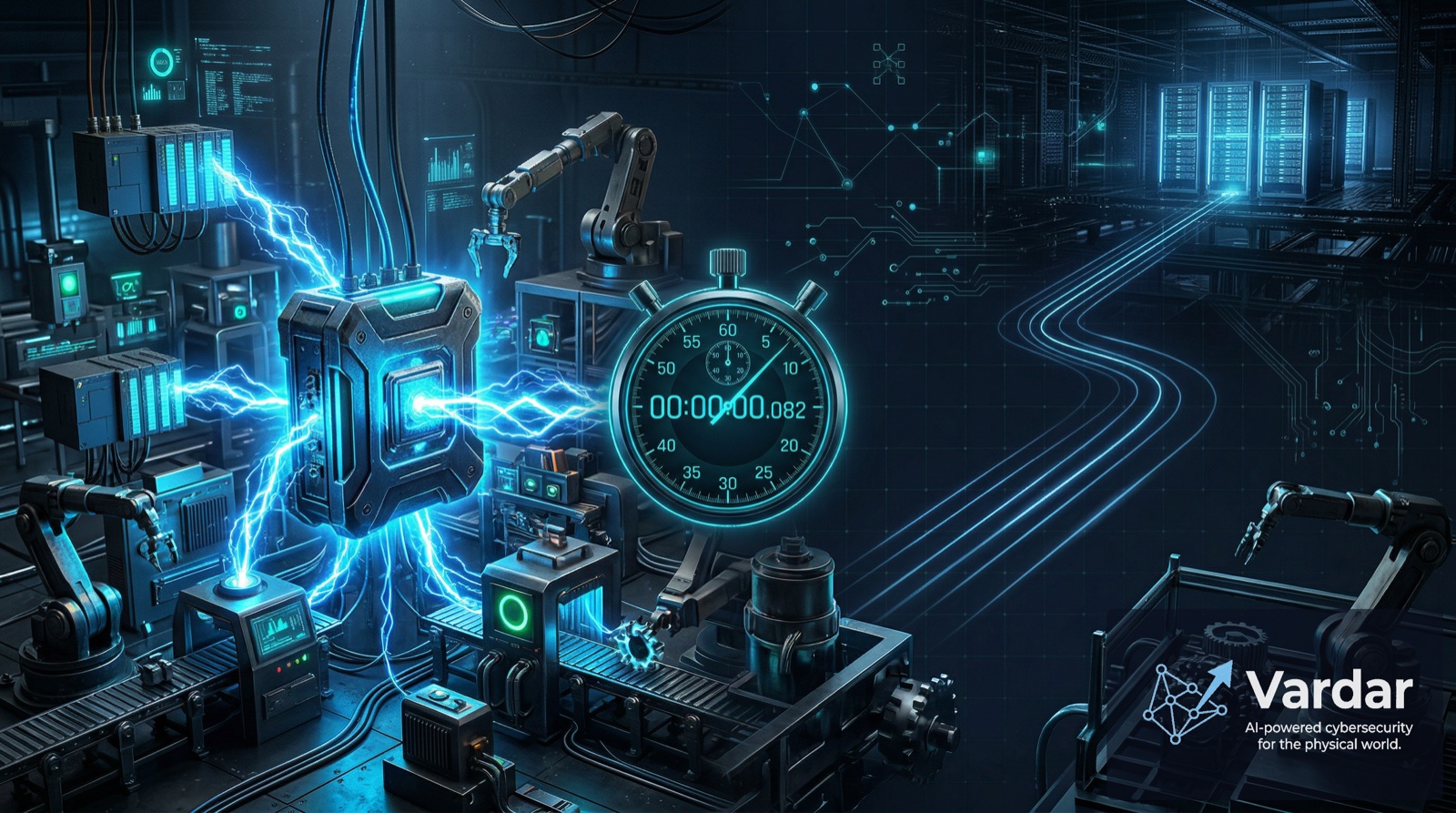
When Speed Is the Difference Between Safety and Catastrophe
In IT cybersecurity, a detection delay of a few seconds is an inconvenience. In OT environments — where PLCs control chemical processes, turbines spin at thousands of RPM, and robotic arms move at machine speed — that same delay can mean physical damage, safety incidents, or worse.
This is the fundamental problem with cloud-only security architectures in industrial environments. And it is why edge AI is rapidly becoming the cornerstone of modern OT threat detection.
The numbers tell the story: edge computing delivers response times of 1–10 milliseconds, while cloud processing typically ranges from 50 to over 200 milliseconds for round-trip communications. In a high-speed manufacturing line processing 60 parts per second, a one-second cloud delay means over 30 potentially defective products. A five-second lag in safety systems could mean catastrophic equipment damage.
For cybersecurity, the stakes are even higher. When a threat actor manipulates a process variable or injects malicious commands into an industrial protocol, the window for detection and containment is measured in milliseconds, not minutes.
The Cloud-Only Illusion
Cloud-based security platforms have dominated the IT security landscape for good reason. They offer massive computational power, unlimited storage, centralized management, and the ability to correlate data across global deployments. For protecting endpoints, email, and cloud workloads, they work exceptionally well.
But applying this architecture to OT environments introduces critical weaknesses:
Latency that violates physics. For a cloud server to achieve sub-10 millisecond round-trip times, it must be within 200 kilometers of the monitored device. Most industrial facilities do not have cloud data centers next door. The resulting 50–200+ millisecond delays are simply incompatible with real-time OT monitoring requirements.
Network dependency creates a single point of failure. Cloud-only architectures assume persistent, reliable connectivity. Industrial environments routinely face network outages, bandwidth saturation during peak operations, and disruptions from weather events. When the connection to the cloud drops, security monitoring goes dark — precisely when facilities may be most vulnerable.
Bandwidth constraints limit visibility. OT environments generate enormous volumes of telemetry — protocol-level data from hundreds or thousands of devices running protocols like Modbus, DNP3, EtherNet/IP, and PROFINET. Streaming all of this raw data to the cloud is often impractical, forcing organizations to sample or aggregate data and losing the granularity needed to detect sophisticated attacks.
Sensitive operational data leaves the facility. Transmitting raw industrial process data to external cloud servers raises serious concerns about intellectual property protection, data sovereignty, and regulatory compliance. For organizations in critical infrastructure sectors, keeping operational data on-site is not just a preference — it is increasingly a legal requirement.
Cloud-only security architectures create dangerous blind spots in OT environments: when connectivity drops, monitoring goes dark — often precisely when facilities are most vulnerable to attack.
Why Edge AI Changes the Equation
Edge AI flips the architecture. Instead of sending data out for analysis and waiting for results, intelligence runs directly on-site, at the point where data is generated and where threats materialize.
The Center for Strategic and International Studies (CSIS) recently highlighted this strategic shift, describing edge AI as a "cyber force multiplier" for critical infrastructure. Their analysis notes that by running inference directly on-site, facilities can make safety-critical decisions without relying on central servers or cloud connections — a capability they describe as essential for operational resilience.
Here is what edge-first detection delivers in practice:
Microsecond-level threat detection. Processing happens locally, eliminating network round-trip delays entirely. Behavioral anomalies in industrial protocols are identified and flagged the moment they occur, not seconds or minutes later. For attacks that manipulate process variables — the most dangerous class of OT threats — this speed difference is everything.
Continued protection during network disruptions. Edge AI nodes operate autonomously. If connectivity to centralized systems is severed — whether by an attacker, a natural disaster, or routine maintenance — local detection and response capabilities remain fully operational. Each protected facility becomes a self-sufficient security island.
Full-fidelity data analysis. Without bandwidth constraints, edge processors can analyze every packet, every protocol transaction, and every device behavior in real time. No sampling, no aggregation, no blind spots. This granularity is what separates genuine OT threat detection from IT security tools relabeled for industrial use.
Data sovereignty by design. Raw operational data never leaves the facility. Only threat intelligence, anonymized behavioral patterns, and security events are shared with centralized systems. This architecture inherently satisfies data sovereignty requirements and protects sensitive operational information.
The Hybrid Model: Edge Intelligence, Collective Defense
The most effective architecture is not edge-only or cloud-only — it is a hybrid model where edge and cloud complement each other. As CSIS researchers concluded, "the goal should not be to abandon centralized networks, but to build a hybrid model where edge AI adds a resilience layer."
This is precisely the philosophy behind Vardar's architecture. Our Edge AI Sentinel handles the time-critical work: real-time protocol inspection, behavioral baseline monitoring, and immediate threat detection at each facility. Response times are measured in milliseconds, and protection continues regardless of connectivity status.
Meanwhile, our Hive Mind collective intelligence layer aggregates anonymized threat patterns across all deployments. When one facility detects a novel attack technique, that intelligence is shared across the entire network — strengthening detection for everyone without exposing any individual facility's operational data.
The Millisecond Imperative
As OT environments continue to converge with IT networks and as attackers grow more sophisticated, the margin for detection and response shrinks. Regulations like NIS2 demand 24-hour incident reporting — a timeline that starts with detection, which must be as close to instantaneous as possible.
The organizations that will maintain operational resilience in 2026 and beyond are the ones investing in edge-first detection architectures. Not because cloud is irrelevant, but because in OT, milliseconds are the difference between a detected anomaly and a physical incident.